
Introduction: A World at a Political Crossroads
The global political landscape in April 2026 is marked by uncertainty, high-stakes diplomacy, and emerging challenges that go beyond traditional geopolitics. From escalating tensions in the Middle East to the growing political impact of climate change, world leaders are facing pressure on multiple fronts.
⚠️ Middle East Crisis: Fragile Ceasefire Raises Global Concerns
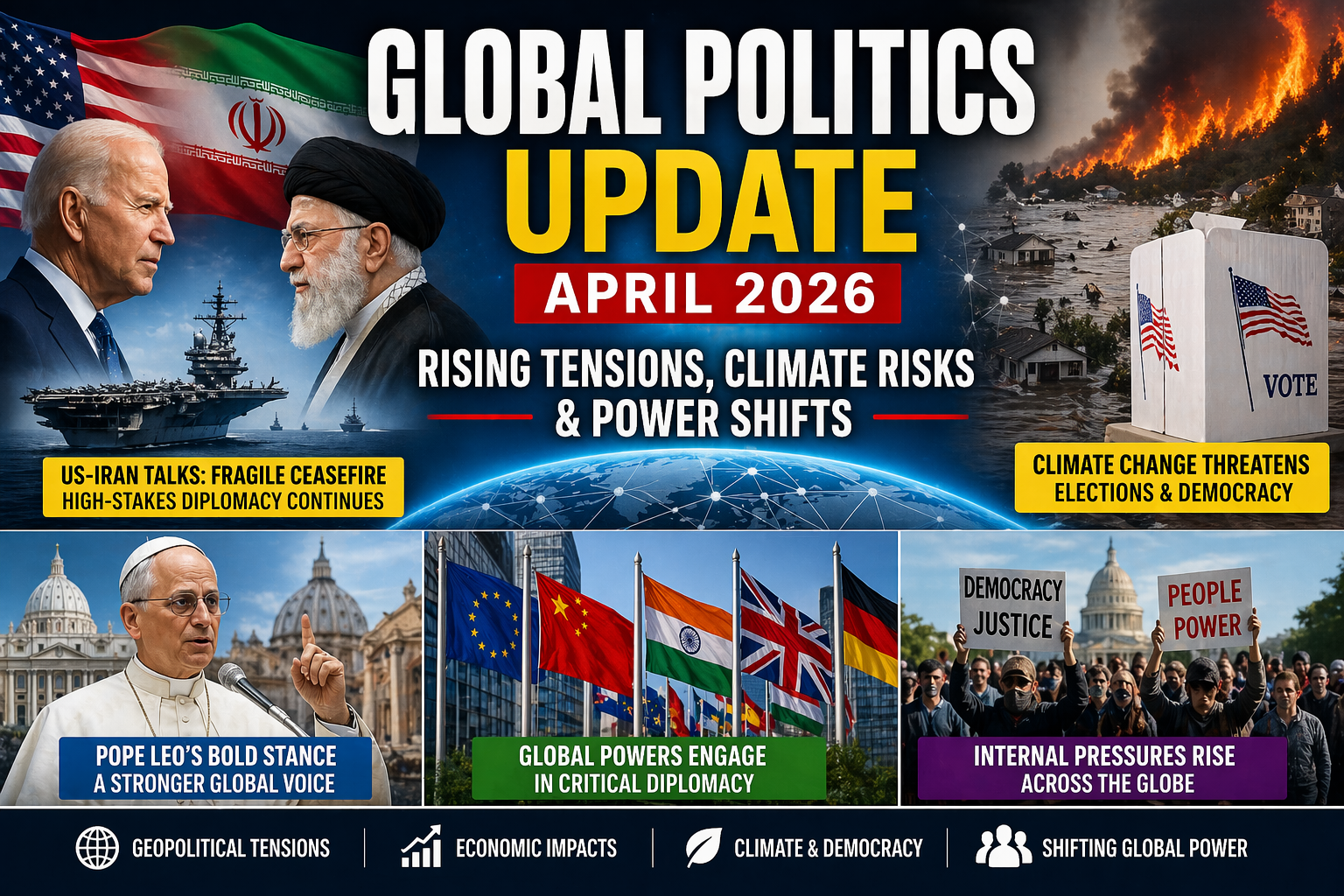
The spotlight remains on the Middle East, where a delicate ceasefire between the United States and Iran is under intense scrutiny. Diplomatic negotiations are ongoing, but the situation remains unpredictable.
Global powers such as the United Kingdom and France are actively involved in securing critical trade routes like the Strait of Hormuz. This region is vital for global oil supply, and any disruption could trigger economic consequences worldwide.
The uncertainty surrounding Iran’s participation in upcoming talks has added further tension, leaving the international community on edge.
📉 Global Impact: Energy Markets & Supply Chains Under Pressure
The ongoing geopolitical tensions are already affecting the global economy. Oil prices remain volatile, and supply chains are experiencing disruptions.
Countries dependent on energy imports are particularly vulnerable, while businesses worldwide are preparing for potential long-term instability. Humanitarian concerns are also growing, as conflict-affected regions continue to face significant challenges.
🌡️ Climate Change & Politics: A New Global Threat
A recent global report highlights how climate change is increasingly influencing political stability and democratic processes.
Extreme weather events—including floods, wildfires, and heatwaves—are disrupting elections and governance systems. Over the past two decades, nearly 100 elections in more than 50 countries have been affected.
This emerging trend raises serious concerns about the future of democracy in a rapidly changing climate.
⛪ A Stronger Global Voice: Pope Leo’s Political Stand
In a notable shift, Pope Leo has taken a more outspoken position on global political issues. He has criticized economic inequality and ongoing conflicts, signaling a stronger moral stance from the Vatican.
This marks a change from traditional neutrality and positions him as an influential voice in global political discourse.
🌐 Regional Politics: Internal Pressures Across Continents
Beyond global conflicts, many countries across Europe, Asia, and Africa are dealing with internal political challenges.
From economic reforms to election disputes, governments are navigating complex domestic issues while also responding to international developments. The interconnected nature of modern politics means that no region remains unaffected.
📊 Conclusion: An Interconnected and Uncertain Future
The current global political environment reflects a world that is more interconnected—and more fragile—than ever before.
As diplomacy continues and new challenges emerge, the coming months will be critical in shaping the direction of global stability, economic growth, and international cooperation.