

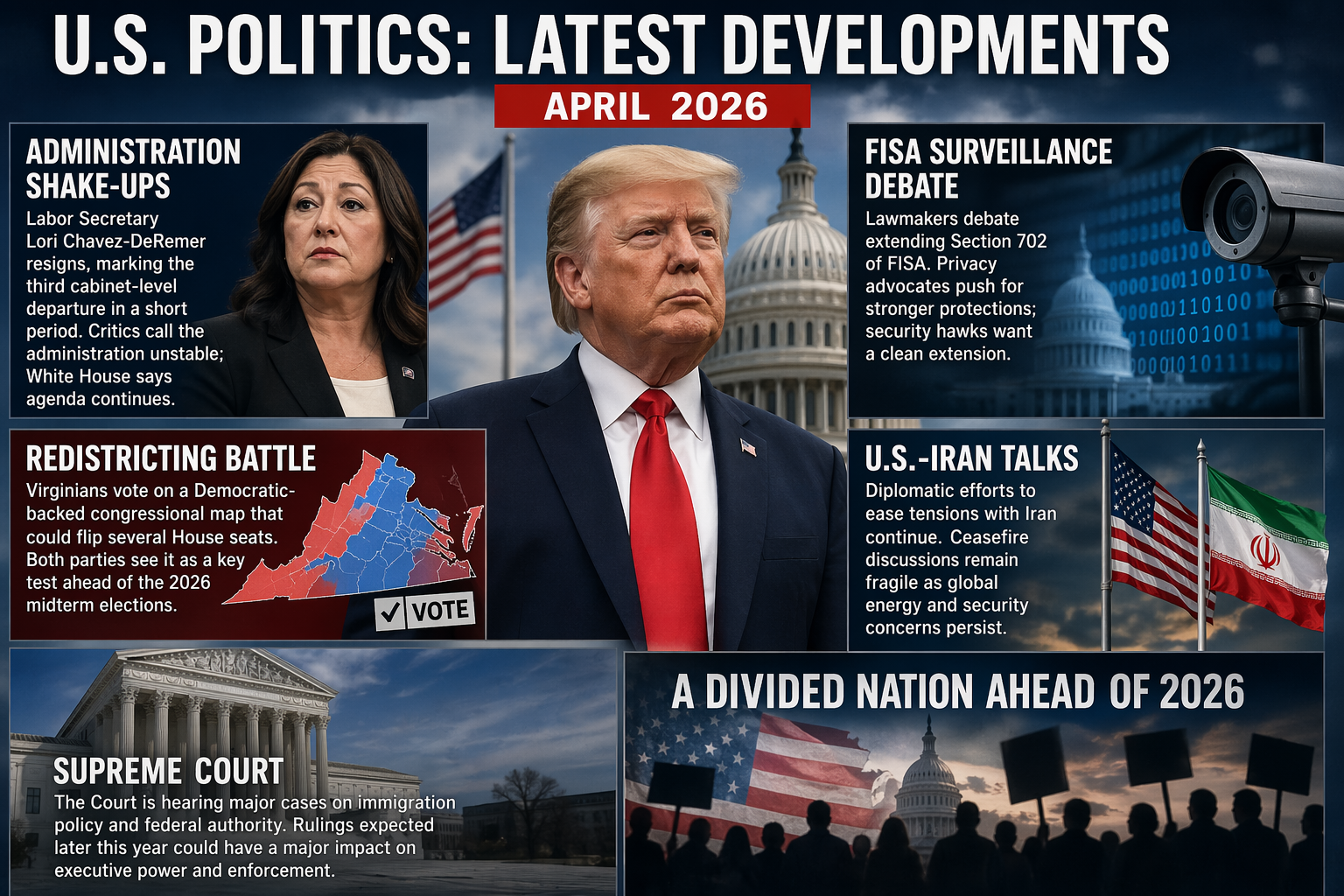
In Washington, President Donald Trump’s administration is facing increasing internal pressure after a wave of high-level resignations. Most recently, Labor Secretary Lori Chavez-DeRemer stepped down, becoming the third cabinet-level departure in a short period. The resignations have fueled criticism from Democrats, who argue the administration is becoming unstable, while the White House maintains it is continuing its policy agenda without disruption.
At the same time, Congress is deeply divided over surveillance laws. Lawmakers are debating whether to extend Section 702 of the Foreign Intelligence Surveillance Act (FISA), which allows intelligence agencies to monitor foreign communications. The debate has become politically charged, with privacy advocates demanding stronger protections for Americans’ data, while security hawks push for a clean extension without changes.
On the legislative front, redistricting battles are intensifying ahead of the 2026 midterm elections. In Virginia, voters are currently deciding on a Democratic-backed congressional map that could shift control of several House seats, potentially reshaping the balance of power in Congress. Both parties are heavily investing in the outcome, viewing it as a key test of voter sentiment ahead of November.
Meanwhile, foreign policy continues to influence domestic politics. U.S. diplomatic efforts to manage tensions with Iran remain ongoing, with high-level negotiations and ceasefire discussions still fragile. The situation has added pressure on the White House, as global energy prices and security concerns remain linked to the outcome.
Elsewhere, legal and constitutional debates are active in the Supreme Court, where key cases involving immigration policy and federal authority are under review. Several rulings expected later this year could significantly shape executive power and immigration enforcement going forward.